

Alibaba's Qwen3.8-Max, a 2.4-trillion-parameter multimodal model, directly challenges the effectiveness of US restrictions on AI chip sales to China. The model's release confirms that Chinese AI development has not been slowed by export controls.
The news comes after the US tightened rules on advanced chip exports, aiming to curb China's AI capabilities. Alibaba's model, with its massive scale and open availability, signals that such measures may be too late.
Find Original Home Decor sparking conversation at Grand Goldman Shop.

What Is Qwen3.8-Max and Why It Matters
Qwen3.8-Max is Alibaba's most ambitious AI model to date. It is multimodal, meaning it can process text, images, and likely other data types, and boasts a context window of one million tokens—enough to handle entire books or lengthy codebases.
Two features stand out: it is open (unlike previous Qwen versions that were closed) and enormous, with 2.4 trillion parameters. This scale puts it in the same league as frontier models from OpenAI and Anthropic.
The model's release is a direct challenge to the narrative that US chip restrictions would cripple China's AI progress. By going open, Alibaba also invites global scrutiny and collaboration, potentially accelerating adoption.
Benchmarks: Competing with GPT-5.6 Sol and Fable 5
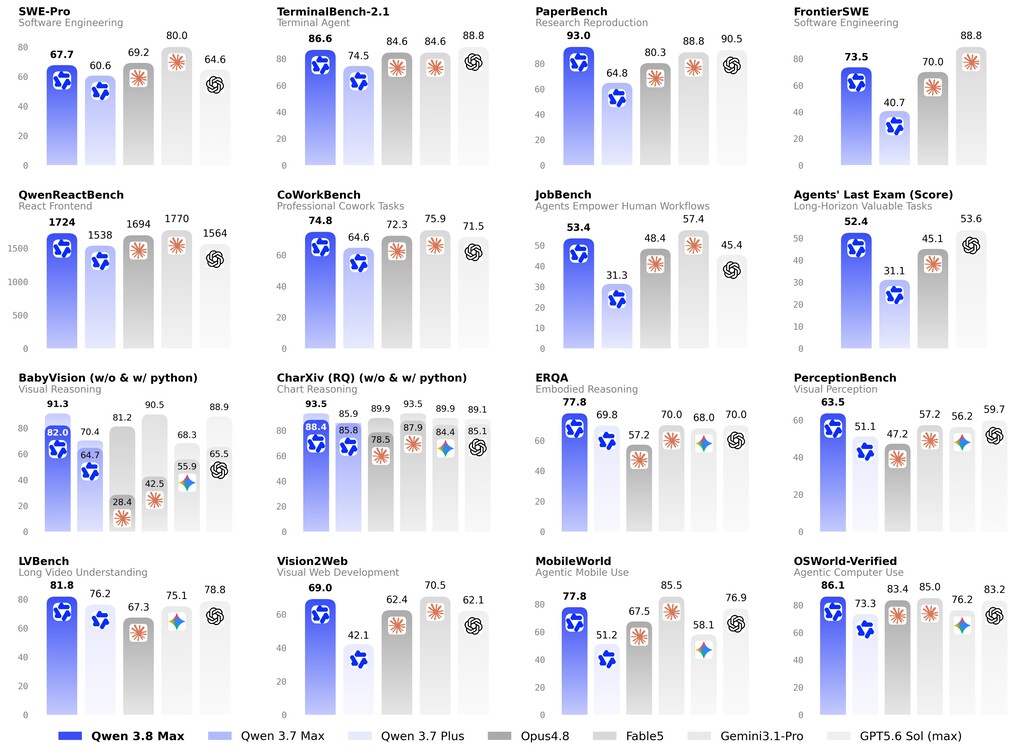
Alibaba's internal benchmarks show Qwen3.8-Max trading blows with GPT-5.6 Sol and Fable 5. It excels in some areas and lags in others, but overall demonstrates parity with top US models.
These results, while not independently verified, suggest that Chinese models are no longer trailing. The AI race is now truly competitive, with implications for global tech leadership.
Independent validation will be crucial, but the initial data is compelling. It also raises questions about the effectiveness of export controls.
Beyond Conversation: A Model That Works
Qwen3.8-Max is designed for action, not just chat. It performs well in software engineering, terminal operations, visual perception, and controlling computers and mobile devices.
These benchmarks measure the ability to use tools and complete long tasks—capabilities essential for autonomous agents. This shift from conversational AI to actionable AI is a key trend.
Alibaba's focus on practical tasks suggests the model is intended for enterprise and developer use, where automation can drive productivity.
The US Chip Restrictions: A Desperate Measure?
The US restricted AI chip sales to China to slow its progress in advanced AI. But Alibaba's model shows that such measures may be insufficient.
Chip restrictions can only delay, not stop, innovation. Chinese companies have invested heavily in domestic chip design and alternative architectures. Moreover, open models can be trained on older hardware with clever optimization.
The restrictions may have been a desperate attempt to maintain a lead that is already eroding. Alibaba's release confirms that the gap is closing.
What to Watch Next
Independent benchmarks will reveal Qwen3.8-Max's true capabilities. Its open nature means the global AI community can test and build upon it. The background to this story is set out in Alibaba's Joe Tsai: Open Source AI Is Europe's Only Tech Sovereignty Path. A related thread runs through Nvidia Eyes Reflection AI Acquisition to Counter Custom AI Chips. Earlier coverage in Alibaba's New AI Chip Takes Aim at Nvidia's Dominance shows how the argument developed.
How US policymakers respond will also matter. Further restrictions could backfire, spurring China's self-sufficiency. Meanwhile, the AI race continues to accelerate. A closer look at the same subject appears in Chinese AI Chips Face 50% Price Surge as HBM Memory Shortage Bites. Anyone following the wider picture can start with Alibaba's RISC-V Chips Hit 6 Billion Units in AI Push. The same theme surfaces in China's AI Infrastructure Strategy Expands to Brazil with Alibaba Cloud, which takes a different angle.
For businesses, this means more choices and faster innovation. For the US, it's a wake-up call. Context on how this played out before sits in China chips away at US AI lead: Silicon Valley on edge.
Key Takeaways
- Alibaba's Qwen3.8-Max is a 2.4-trillion-parameter open multimodal model with a one-million-token context window.
- Internal benchmarks show it competing with top US models like GPT-5.6 Sol and Fable 5.
- It excels in software engineering, terminal control, and device operation, signaling a shift to actionable AI.
- The model's release challenges the effectiveness of US chip export restrictions.
- Independent validation and policy responses are the next critical steps.
Comparison of Qwen3.8-Max with US Frontier Models
| Feature | Qwen3.8-Max | GPT-5.6 Sol | Fable 5 |
|---|---|---|---|
| Parameters | 2.4 trillion | Not disclosed | Not disclosed |
| Openness | Open | Closed | Closed |
| Context Window | 1 million tokens | Unknown | Unknown |
| Multimodal | Yes | Yes | Yes |
| Tool Use | Strong | Strong | Strong |
Note: Parameter counts for US models are not publicly disclosed.
FAQ
What is Qwen3.8-Max?
Qwen3.8-Max is Alibaba's latest AI model, featuring 2.4 trillion parameters, multimodal capabilities, and a one-million-token context window. It is open and designed for complex tasks.
How does it compare to US models?
Internal benchmarks show it performing on par with GPT-5.6 Sol and Fable 5 in some areas, though independent tests are needed.
Why is the model being open significant?
Openness allows global researchers to test and build upon it, accelerating innovation and challenging closed models.
Do US chip restrictions still matter?
They may slow but not stop China's AI progress, as Alibaba's model demonstrates. The restrictions could spur domestic chip development.
Browse the Shop
 Acacia frida deluxe solid wood bed frame |
Bedroom bench |
Bed chest drawers |
Lingerie dresser |
Frame base |
Mirror with jewelry storage |
30 Bathroom Vanity |
Memory foam queen mattress |
Mattresses for back pain |
Nightstand set of 2 |
Grand Goldman Shop |
Civil Lawyer
Deutschland Trikot WM 2026







