

Tokenmaxxing, the trend of maximizing AI token consumption, has given way to tokenwasting, where vast amounts of AI-generated output are discarded or reworked. This shift is raising alarms as companies realize they are spending fortunes on AI without seeing proportional productivity gains.
What Is Tokenmaxxing and Why Did It Become a Problem?
Tokenmaxxing refers to the enthusiastic, often indiscriminate use of AI models to generate as much text or code as possible, driven by the belief that more AI equals more value. However, this approach has led to tokenwasting, where a significant portion of AI output is wasted due to errors, irrelevance, or the need for extensive revision. A study by EntelligenceAI reveals that for every dollar invested in AI, only 18 cents make it to production, with the remaining 82% spent on fixing mistakes, rewriting code, and review processes that add no direct value.
Find Original Home Decor sparking conversation at Grand Goldman Shop.

The Real Cost of AI Waste
The financial implications are staggering. Companies are pouring money into AI tools and infrastructure, expecting a productivity boost, but instead find themselves mired in costly correction cycles. Andrew Macdonald, COO of Uber, openly questioned whether the massive AI spending by companies like his is justified when it doesn't translate into productivity improvements. This skepticism is growing as businesses scrutinize their AI investments. The longer history behind the story is traced in Amazon Employees Inflate AI Token Metrics with Tokenmaxxing.
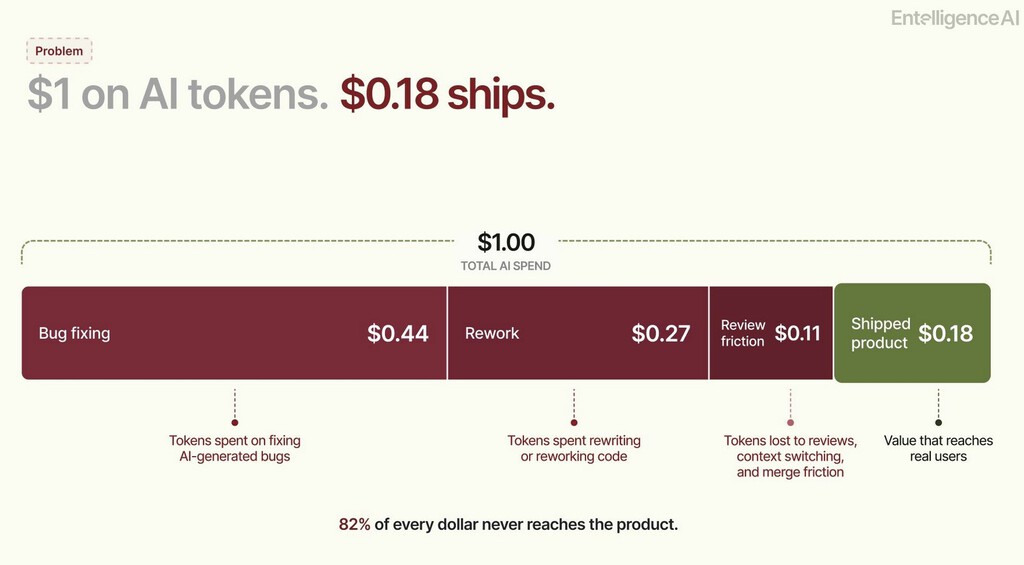
- Only 18% of AI spend reaches production, meaning 82% is wasted on rework and errors.
- Tokenmaxxing encourages overuse without regard for quality or relevance.
- Productivity gains are elusive when AI output requires extensive human intervention.
- Companies like Uber are reassessing their AI strategies to ensure ROI.
- The cost of AI is not converging with electricity as once predicted, remaining high.
Why AI Costs Haven't Fallen as Predicted
A year ago, Sam Altman predicted that as data center production automates, the cost of AI should converge with the cost of electricity, making access extremely cheap. That hasn't happened. Instead, the complexity of AI models and the inefficiencies in their application have kept costs high. The tokenwasting phenomenon exacerbates this by driving up consumption without corresponding value. The background to this story is set out in DeepSeek Gains Ground Among US Companies as AI Costs Bite. A related thread runs through Atlassian AI Spending Caps: Tokenmaxxing Trend Reversed. Earlier coverage in AI's Green Algorithm: How Software Cuts Energy Costs shows how the argument developed.
Who Is Affected by Tokenwasting?
The impact spans industries. Software development teams generate code with AI, only to spend hours debugging and rewriting. Marketing departments produce content that requires heavy editing. Customer support bots generate responses that miss the mark. In each case, the promise of AI efficiency is undermined by the need for human oversight, eroding the very productivity gains that justified the investment. A closer look at the same subject appears in Big Tech AI Spending: When Booming Profits Meet Soaring Costs. Anyone following the wider picture can start with Revolut Cuts AI Coding Costs 10x by Switching 2,000 Engineers to GLM 5.3. The same theme surfaces in Lloyds Bank AI Strategy Cuts £2bn Costs, Boosts Growth, which takes a different angle.
What to Watch Next: The Shift to Efficient AI Use
As awareness of tokenwasting grows, companies are likely to pivot toward more strategic AI deployment. This includes better prompt engineering, fine-tuning models for specific tasks, and implementing robust review processes to minimize waste. The focus will shift from tokenmaxxing to tokenoptimizing—using AI judiciously to achieve measurable outcomes. Context on how this played out before sits in Ai Video: latest articles. A companion piece, AI at Work Saves Time Then Adds Hours of Fixes, approaches the same subject from another angle.
| Metric | Tokenmaxxing Era | Tokenwasting Reality |
|---|---|---|
| AI spend reaching production | Assumed high | 18% (study by EntelligenceAI) |
| Primary use of AI budget | Generation | Error correction and rework |
| Productivity impact | Expected boost | Often negligible or negative |
| Cost trend | Predicted to fall to electricity levels | Remains high |
FAQ
What is tokenmaxxing?
Tokenmaxxing is the practice of maximizing AI token consumption, often without regard for efficiency or value. It became a trend as companies sought to leverage AI extensively, but it has led to tokenwasting, where much of the output is wasted.
How much of AI spending is wasted?
According to a study by EntelligenceAI, only 18 cents of every dollar invested in AI reaches production. The remaining 82% is spent on correcting errors, rewriting code, and other non-value-adding activities.
Why is AI not as cheap as predicted?
Sam Altman predicted that AI costs would converge with electricity costs, but this hasn't materialized. The complexity of AI models and inefficiencies like tokenwasting have kept costs high.
What can companies do to avoid tokenwasting?
Companies should focus on strategic AI deployment, including better prompt engineering, fine-tuning models, and implementing review processes to minimize waste. The goal is to shift from tokenmaxxing to tokenoptimizing.
Browse the Shop
 Acacia frida deluxe solid wood bed frame |
Bedroom bench |
Bed chest drawers |
Lingerie dresser |
Frame base |
Mirror with jewelry storage |
30 Bathroom Vanity |
Memory foam queen mattress |
Mattresses for back pain |
Nightstand set of 2 |
Grand Goldman Shop |
Civil Lawyer
Deutschland Trikot WM 2026







