

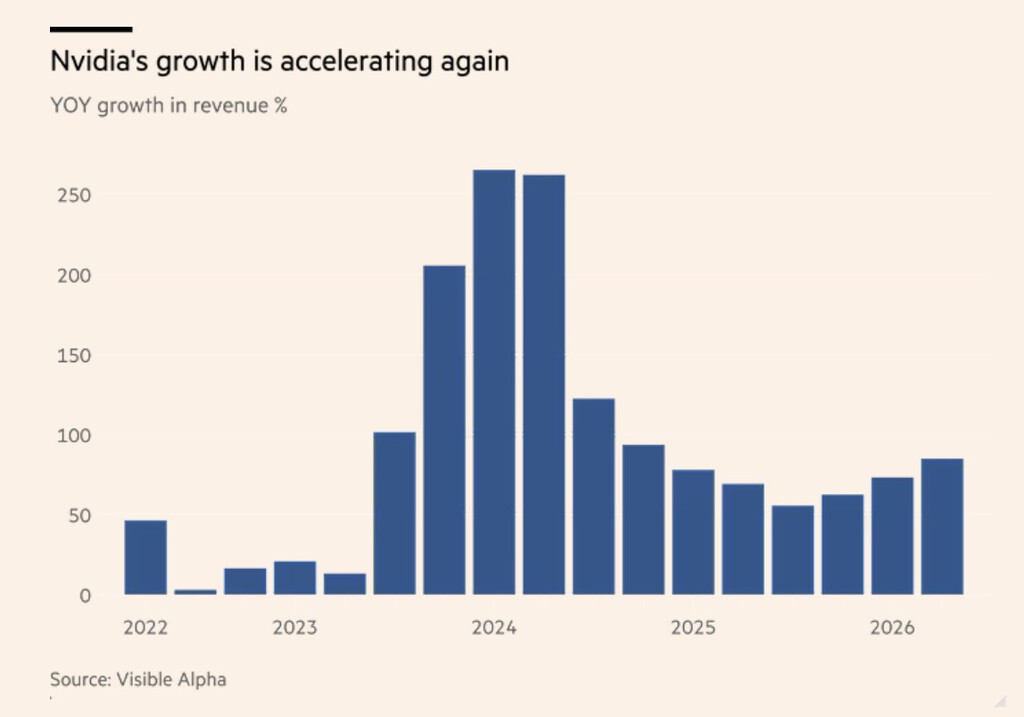
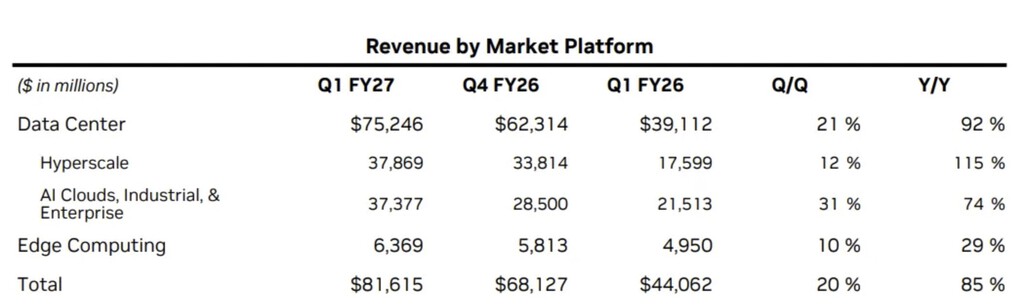
Nvidia's first-quarter fiscal 2027 results are simply staggering: $81.6 billion in revenue, an 85% year-over-year increase, and all of it achieved without selling a single chip in China. The company founded in 1993 to make graphics chips for video games has transformed into an AI powerhouse, and the latest numbers show just how completely that shift has reshaped its business.
Nvidia's Q1 Revenue by Segment
Nvidia reported $81.6 billion in total revenue for the quarter, a figure so large it rivals the GDP of countries like Croatia, Panama, or Uruguay. The data center segment accounted for $75.2 billion of that total, growing 92% compared to the same period last year. Meanwhile, the gaming business, once Nvidia's core, generated $6.4 billion—up 29% annually but now representing less than 8% of total revenue.
Find Original Home Decor sparking conversation at Grand Goldman Shop.

That means gaming, while still healthy in absolute terms, has become almost a footnote for Nvidia. The AI boom has turned the company's original business into a relatively minor contributor, as demand for data center GPUs continues to skyrocket.

Gaming's Declining Share of Nvidia's Business
For any other semiconductor company, $6.4 billion in quarterly gaming revenue would be extraordinary. But for Nvidia, it's pocket change compared to the data center juggernaut. The gaming segment grew 29% year-over-year, which is impressive on its own, but it's dwarfed by the 92% growth in data centers.
This shift underscores how thoroughly AI has redefined Nvidia's trajectory. The company that once lived and died by the gaming market now sees its future—and its present—in AI infrastructure.
What's Driving Nvidia's Data Center Growth
The data center segment's 92% growth is fueled by insatiable demand for AI training and inference. Hyperscalers, enterprises, and governments are all racing to build out AI capabilities, and Nvidia's GPUs remain the gold standard for accelerated computing.
Even more remarkable: Nvidia achieved these results without any meaningful revenue from China, a massive market that has historically been a significant contributor. Export restrictions have limited Nvidia's ability to sell advanced chips there, yet the company still posted record numbers.
Key Takeaways from Nvidia's Q1
- Total revenue reached $81.6 billion, up 85% year-over-year.
- Data center revenue hit $75.2 billion, growing 92% annually.
- Gaming revenue was $6.4 billion, up 29% but less than 8% of the total.
- Nvidia achieved these results without selling chips in China.
- The company's transformation from gaming to AI is complete.
Nvidia's Revenue Breakdown: Then vs. Now
| Segment | Q1 Fiscal 2027 Revenue | Year-over-Year Growth | Share of Total |
|---|---|---|---|
| Data Center | $75.2 billion | +92% | ~92% |
| Gaming | $6.4 billion | +29% | ~8% |
| Total | $81.6 billion | +85% | 100% |
Why This Matters for Investors and the Tech Industry
Nvidia's results signal that the AI infrastructure buildout is far from over. Despite growing concerns about a slowdown, the company's data center business accelerated, suggesting that demand for AI compute remains robust. For investors, Nvidia's ability to grow at this scale without China is a testament to the breadth of the AI boom.
For the broader tech industry, Nvidia's dominance in AI chips poses both an opportunity and a challenge. Competitors are racing to catch up, but Nvidia's hardware and software ecosystem creates a formidable moat. The company's success also highlights the growing importance of AI in the global economy. The background to this story is set out in Ireland Data Centers Now Use 23% of National Electricity. A related thread runs through Amazon Data Centers' Water Use Revealed: 2.5 Billion Gallons. Earlier coverage in Samsung AI Chips Propel Record Quarterly Profit, Surpassing Nvidia shows how the argument developed.
What to Watch Next for Nvidia
Looking ahead, Nvidia faces several key questions. Can it sustain this growth rate as the AI market matures? Will export restrictions to China ease, potentially unlocking additional revenue? And how will competitors like AMD and Intel respond with their own AI chips? A closer look at the same subject appears in Google Sends AI Chips to Space in Project Suncatcher Test. Anyone following the wider picture can start with ByteDance Builds Own AI Chips as Intel and AMD Prices Soar. The same theme surfaces in Conjunctively: 14 Better Ways to Say It Clearly and Simply (Guide), which takes a different angle.
For now, Nvidia's momentum seems unstoppable. The company's ability to deliver such staggering results without China demonstrates the sheer scale of the AI opportunity. As Jensen Huang's company continues to innovate, all eyes will be on whether it can maintain this pace. Context on how this played out before sits in Ulanqab: The Chinese City Powering AI Data Centers. A companion piece, Data Centers Consume Water, Power and Money But Not Workers, approaches the same subject from another angle.
FAQ
How much revenue did Nvidia report in Q1 fiscal 2027?
Nvidia reported $81.6 billion in total revenue for the first quarter of fiscal 2027, an 85% increase year-over-year.
Why is Nvidia's gaming segment no longer significant?
While gaming revenue grew 29% to $6.4 billion, it now represents less than 8% of Nvidia's total revenue due to the explosive growth of data center AI chips.
Did Nvidia sell any chips in China during the quarter?
No, Nvidia did not sell any chips in China during the quarter, yet still achieved record revenue.
What drove Nvidia's data center growth?
The data center segment grew 92% to $75.2 billion, driven by surging demand for AI training and inference across hyperscalers, enterprises, and governments.
Browse the Shop
 Acacia frida deluxe solid wood bed frame |
Bedroom bench |
Bed chest drawers |
Lingerie dresser |
Frame base |
Mirror with jewelry storage |
30 Bathroom Vanity |
Memory foam queen mattress |
Mattresses for back pain |
Nightstand set of 2 |
Grand Goldman Shop |
Civil Lawyer
Deutschland Trikot WM 2026







