

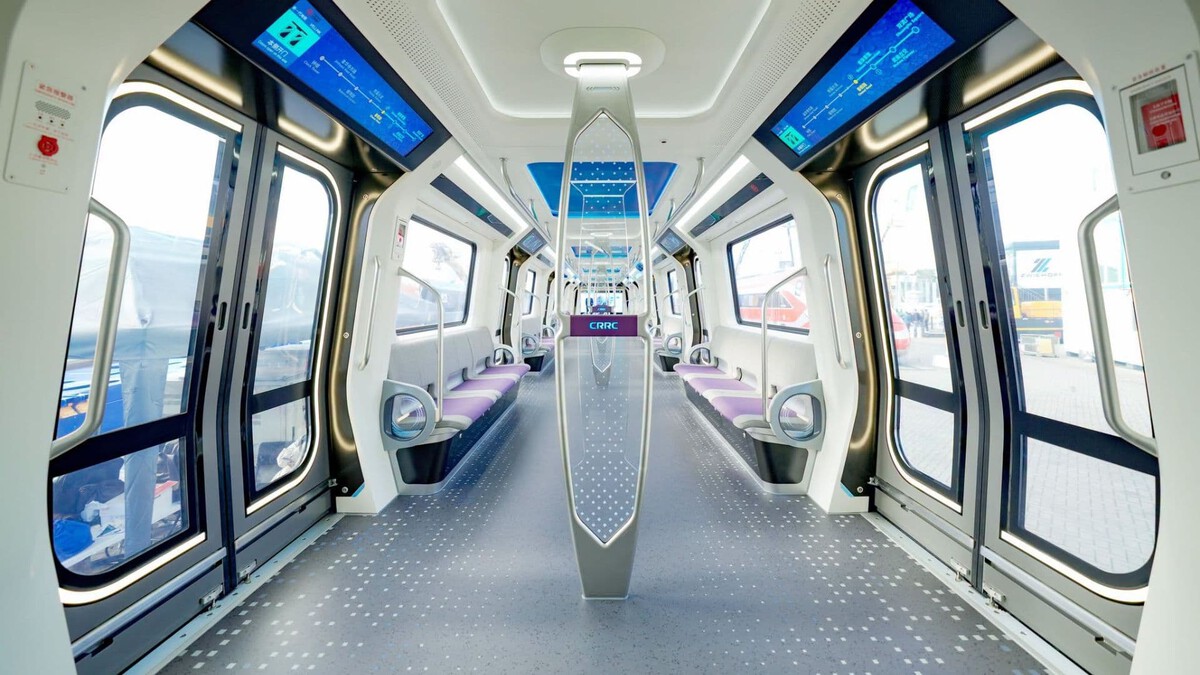
China's state-owned rail manufacturer CRRC has just unveiled VELLINK, an AI-powered metro that aims to push urban transit beyond traditional automation. Developed by subsidiary CRRC Changchun with Chengdu Rail Transit Group and other partners, the vehicle represents a significant step toward integrating artificial intelligence into everyday subway operations. While driverless trains have existed for decades, VELLINK suggests a future where AI handles more than just driving—it could optimize entire networks in real time.
Why AI in Metros Matters Now
Metro systems worldwide are under pressure to move more people with fewer resources. Automation has long been a solution: Paris opened its fully automated Line 14 in 1998, and Barcelona debuted its driverless Line 9 in 2009. These systems rely on sensors and control algorithms, but they don't necessarily use artificial intelligence. VELLINK changes that by incorporating AI to potentially improve decision-making, energy efficiency, and passenger flow.
Find Original Home Decor sparking conversation at Grand Goldman Shop.

The timing is critical. Cities are expanding, and aging infrastructure struggles to keep up. AI could help squeeze more capacity from existing tracks while reducing operating costs. For riders, that might mean shorter waits and smoother rides—if the technology delivers on its promises.
What Makes VELLINK Different
CRRC's VELLINK is not just another driverless train. It's designed as a holistic system where AI monitors and adjusts operations continuously. According to the company, the metro can analyze data from onboard sensors and external sources to predict maintenance needs, adapt to passenger demand, and even respond to emergencies faster than human operators.
While full details are scarce, the collaboration with Chengdu Rail Transit Group suggests VELLINK will be tested in a real urban environment. Chengdu, a rapidly growing megacity, provides the perfect proving ground for AI-driven transit.
Key Features of AI-Powered Metros
- Predictive maintenance: AI anticipates component failures before they cause delays.
- Dynamic scheduling: Trains adjust frequency based on real-time passenger counts.
- Energy optimization: AI reduces power consumption by smoothing acceleration and braking.
- Enhanced safety: Sensors and algorithms detect obstacles and anomalies faster than humans.
- Passenger experience: Real-time information and personalized alerts improve journeys.
How VELLINK Compares to Existing Systems
Not all automated metros are created equal. Older systems like Paris Line 14 use fixed automation—trains follow predetermined paths with limited flexibility. AI-powered systems like VELLINK aim to be adaptive, learning from data to improve over time. The table below highlights the differences.
| Feature | Traditional Automation (e.g., Paris Line 14) | AI-Powered Metro (e.g., VELLINK) |
|---|---|---|
| Decision-making | Rule-based, fixed logic | Adaptive, learns from data |
| Maintenance | Scheduled, reactive | Predictive, proactive |
| Energy use | Optimized for typical patterns | Real-time optimization |
| Passenger flow | Static schedules | Dynamic scheduling |
| Safety response | Pre-programmed | AI-assisted anomaly detection |
What This Means for Cities Worldwide
VELLINK signals China's ambition to lead in smart transportation. If successful, the technology could be exported to other countries, much like CRRC's trains already are. For cities considering upgrades, AI metros offer a way to leapfrog traditional automation without rebuilding entire lines.
However, challenges remain. AI systems require massive data and robust cybersecurity. Trust is also an issue—passengers need to feel safe without a driver. CRRC will need to prove VELLINK's reliability through extensive testing. The background to this story is set out in Driverless Cars: Are They Really the Future of Driving. A related thread runs through Why I Can't Wait to Get Into a Driverless Car.
The Road Ahead for AI in Public Transit
Metro automation has come a long way since the first driverless lines. AI represents the next frontier, promising smarter, more efficient networks. As Madrid's Line 6 prepares for full automation by 2027, and cities like Chengdu test VELLINK, the race for AI-driven transit is heating up. Earlier coverage in Car: latest articles shows how the argument developed. A closer look at the same subject appears in San Francisco Metro Still Runs on Floppy Disks Until 2034.
For now, VELLINK is a glimpse of what's possible. Its success will depend on real-world performance and regulatory approval. But one thing is clear: the future of metro travel will be increasingly intelligent, and China is positioning itself at the forefront. Anyone following the wider picture can start with London Robotaxi Rollout Faces Growing Calls for Limits. The same theme surfaces in Uber Self-Driving Robotaxi Trial Begins in Manchester Streets, which takes a different angle.
FAQ
What is VELLINK?
VELLINK is an AI-powered metro developed by CRRC Changchun, a subsidiary of Chinese rail manufacturer CRRC, in collaboration with Chengdu Rail Transit Group. It aims to integrate artificial intelligence into subway operations for improved efficiency and safety.
Is VELLINK fully driverless?
Yes, VELLINK is designed to operate without a driver, but it goes further by using AI to optimize scheduling, maintenance, and energy use. It represents an evolution from traditional automated metros.
When will VELLINK enter service?
CRRC has not announced a specific timeline for commercial service. Testing with Chengdu Rail Transit Group is expected to begin soon, with potential deployment in the coming years.
How does VELLINK compare to existing driverless metros?
Unlike older systems that rely on fixed automation, VELLINK uses AI to adapt to changing conditions, predict maintenance needs, and optimize operations in real time. This could lead to greater efficiency and reliability.
Browse the Shop
 Acacia frida deluxe solid wood bed frame |
Bedroom bench |
Bed chest drawers |
Lingerie dresser |
Frame base |
Mirror with jewelry storage |
30 Bathroom Vanity |
Memory foam queen mattress |
Mattresses for back pain |
Nightstand set of 2 |
Grand Goldman Shop |
Civil Lawyer
Deutschland Trikot WM 2026







